
TimeProvider 4100 r2.5
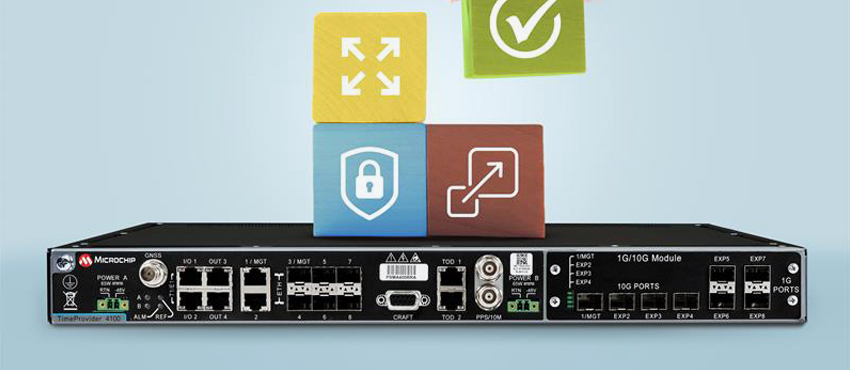
- Product Information
- Key Features
- Datasheets
- Request a quote
Product Information
Precise Timing Grandmaster with Gateway Clock, High-Accuracy and Redundancy
TimeProvider 4100 r2.5 Precise Timing Grandmaster is a family of solutions based on a hardware platform with a choice of oscillators that can be complemented by optional expansion modules and by unique differentiating software options that are made available in successive releases. This approach ensures the preservation of investments in a platform that evolves with industry needs and standard evolutions.
Critical infrastructure communication networks require highly accurate, resilient and secure IEEE® 1588-compliant Grandmasters for precise time and synchronisation to avoid interferences and optimise the wireless spectrum. Our TimeProvider 4100 series is an innovative and flexible hardware platform with unique differentiating software options and multiple operation modes that you can deploy at core sites, aggregation sites, fronthaul or backhaul. Our TP4100 is an investment in a platform that will evolve with industry needs.
Version 2.5 now supports X.509 certificates. Please download the Technical Product Brochure for details.
Watch Microchip’s video to learn more about TimeProvider 4100
TimeProvider 4100 v2.5 Highlights
TimeProvider 4100 r2.5 Precise Timing Grandmaster builds upon prior releases by adding the following key capabilities:
In the virtual Primary Reference Time Clock (vPRTC) architecture, to minimise the dependency on GNSS, receivers are only required in the core enhanced Primary Reference Timing Clock (ePRTC) sites where they can be protected and monitored to shield the network from the risk of GNSS jamming or spoofing threats.
The TP4100 is also capable of getting its time reference from national metrology labs.
The vPRTC architecture ensures redundancy via bi-directional east and west timing flows to local source clocks in aggregation sites with 100 ns of accuracy.
TP4100 provides configuration, status monitoring and integration with up to five TimeProvider XT extension shelves for a maximum of 200 E1/T1/CC/JCC output ports.
You can configure our TP4100 clock in the following ways:
- As a gateway clock to serve timing flow toward 5G Remote Radio Heads (RRHs) as well as for various types of input and output flexibility
- As a high-performance boundary clock to deliver high accuracy over a secure optical network—meets Class D (5 ns) accuracy and is capable of an average 1 ns accuracy, meeting 15 ns accuracy for a chain of 15 boundary clocks
- In ePRTC operation mode to provide 30 ns accuracy at the source of timing chain (now capable of a 40-day holdover)
- In SSU operation mode, the TP4100 can filter the legacy inputs for jitter/wander
Flexible Architecture
- Rich base platform with support for PTP, NTP and legacy frequency timing interfaces
- Ports of many types : 4xE1/T1, 2xRJ45 1GE, 6xSFP 1GE, 2x1pps/ToD, 1 GNSS, 1 Craft
- Optional Expansion Module with 16 outputs each separately configurable as E1/T1/2048 kHz/1544 kHz/Composite-clock (64 kHz)/JCC two inputs CC-IN1 and CC-IN2 can be configured as CC/JCC inputs to module (outputs phase alignment)
- Optional Expansion Module with 4xSFP 1GE and 4xSFP+ 1GE/10GE fan out ports and 100M Fast Ethernet
Best of Breed Grandmaster Clock
- TimeProvider 4100 r2.5 is the industry-leading IEEE 1588 v2 grandmaster with support for multiple profiles per unit and dual server profiles per port
- Telecom 2008, Default profile, G.8265.1, G.8275.1, G.8275.2
- SyncE input & output
- NTP with MD5 security
- Multiple packet services per unit, each port can be configured separately for master or client or probe or NTP
- Dedicated management port (RJ45 or SFP)
- Operator can select number and types of ports and interfaces that are necessary to deploy and scale for use cases such as 5G, cRAN, oRAN, DOCSIS remote/MAC PHY, etc.
- Primary Reference Time Clock : Class A (100ns), Class B (ITU-T G.8272, 40ns), ePRTC (30ns)
- 1000 PTP clients capacity at full rate of 128 packet per second in unicast
- Sub-tenancy model enable double capacity and scalability by using a master unit connected to downstream client units; port count is doubled with two units
Resiliency and Redundancy
- Dual power input for power redundancy
- Fan less device minimises risks associated with rotation and moving parts
- Heat sinks and heat pipes enable great scalability with SFP and SFP+ ports
- Oscillator options (mini OCXO, OCXO, super OCXO, Rubidium) for timekeeping and holdover enhanced performances depending on use case and requirements (edge, aggregation, core)
- Support for all major GNSS Constellations (GPS, GLONASS, BeiDou, Galileo) and SBAS allows for enhanced resiliency by enabling to lock to more satellites
- Support for multi-band GNSS to mitigate time delay due to solar storms and ionosphere effects- each unit is hardware enabled with multi-band receiver and L1 is set per default, upgrade to multi-band does not require a new hardware module
- Microchip’s patented active thermal compensation technology for excellent accuracy of <10ns RMS to UTC (USNO)
- Up to 3 PTP client inputs and IEEE 2.1 2019 majority vote with patented automatic asymmetry compensation (AAC) provides best of class Assisted Partial Timing Support (APTS) on 32 paths as back up to GNSS signal. AAC with APTS mitigates for packet delay variation (PDV), jitter and asymmetry
- Geographical network redundancy for failure leverages IEEE 1588 PTP Best Master Class Algorithm (BMCA)
- Software redundancy (gateway clock or ePRTC operation modes) with no need for additional hardware modules. Two units use Active/StandBy model with direct fibre link, co-location, continuous health monitoring and fast switching from passive to active when needed
- TimeProvider 4100 is a key member of the virtual PRTC solution. TP4100 can be configured as ePRTC, Gateway Clock as well as with High Performance Boundary Clock. vPRTC provides an architecture for redundant, resilient and highly accurate distribution of phase (PRTC-A over long distances) using optical networks such as DWDM
Protection against Jamming and Spoofing
- Firewall capabilities to block any unauthorised protocols
- Secure protocols such as SSH & HTTPS
- Enhanced SSH with configuration of security levels including High Security
- TACACS+ and Radius Authorisation and Authentication (AAA) support
- Radius two-Factor Authentication
- IEEE 1588 2.1 2019 latest security standard support – prong G (architecture guidance) and prong D (monitoring and management)
- Updates for relevant CVEs and other vulnerabilities
- Anti-Jamming and anti-spoofing protections including indicators (Automatic Gain Control AGC and Continuous Wave CW) and remediation measures based on thresholds
Synchronisation Management and Monitoring
- Full FCAPS via Microchip’s TimePictra synchronisation management system and via CLI
- Enhanced performance with TimePictra for status configuration
- webGUI for user friendly display of monitoring configuration and results
- Internal logging, SNMP support
- Dedicated management port on main chassis and also on 1GE/10GE optional module
- In-band management including support for IEEE 1588 master and slave and management on same port
- Monitoring of PTP, 1PPS for phase as well as legacy signals such as E1/T1, 10Mhz. Measurements (TIE, MTIE, TDEV)
- TimePictra can present monitoring results as well as graphs for ePRTC and chains of high performance boundary clocks
Multiple Operation Modes
Mode of Operation is an essential capability focused around which of the multiple inputs can be used as synchronisation reference. The unit can still behave as a fully functional grandmaster from an outputs standpoint and also has the capability to monitor various kinds of inputs, but a key set of specific inputs can be used as reference for a specific Operation Mode. Various Operation Modes will be introduced over time on TimeProvider 4100. TimeProvider 4100 r2.5 now supports three Operation Modes:
- Gateway Clock mode
- High-performance Boundary Clock mode (single domain and multi domain)
- Enhanced Primary Reference Time Clock (ePRTC)
Gateway Clock Mode
- New class of synchronisation device with multiple inputs and fan out capabilities for distribution of timing flows to multiple end points
- Translation of PTP timing profiles
- No license, Gateway Mode is the default of the TimeProvider 4100 device
High Performance Boundary Clock Mode
- High Performance Boundary clock meets Boundary Clock Class C (10ns cTE) and Class D (5ns Max |TE|)
- Single Domain (SD) or Multi Domain (MD)
- MD HP BC is typically used for redundant, resilient and high-accuracy distribution of phase over long distance on optical networks (DWDM)
- Key element of virtual PRTC (vPRTC) end to end solution
- Leverages Optical Timing Channel (OTC) : hop-by-hop deployment of TP4100 HP BC at every optical node, with dedicated lambda for time distribution
- HP BC does not require hardware change, HP BC is enabled by a software option
Enhanced PRTC Mode
- No hardware needed, ePRTC is enabled via software license
- TP4100 ePRTC mode meets ITU-T G.8272.1 30ns
- Flexibility to use a standard Cesium (Time Cesium 4400/4500) or a high performance Cesium (5071A)
- Fully Protected TimeScale
- Holdover Gas Gauge and extended holdover (beyond the 14-day requirement by the standard)
- Commissioning guidance and recommendations
TimeProvider 4100 Applications
- LTE-FDD, LTE-TDD, O-RAN, cRAN, 5G
- Ethernet backhaul-midhaul-fronthaul networks, cable, remote PHY
The Chronos difference
A new generation of communications demands a new generation of timing systems. The TimeProvider 4100 r2.5 has several “personalities” to suit evolving applications, whether that be a standalone GNSS PRTC clock with support for legacy frequency sync, or as a vPRTC network delivering sub 100ns across your whole network in a scalable, resilient, autonomous, and deterministic way. This one platform performs many timing functions, and Chronos can reuse and redeploy TimeProviders in your network as its demands grow.
Key Features
- High capacity: 2000 PTP unicast timeReceiver clocks at 128 PPS
- Reliable fan-less passive thermal operation
- Redundancy via two software mechanism choices using two units, either in active/standby mode or in active/active mode
- Patented enhanced APTS with Automatic Asymmetry Compensation (AAC)
- Embedded GNSS firewall (BlueSky™ technology) for anti-jamming, anti-spoofing protection
- Support for industry-specific profiles for power and Time Sensitive Network (TSN) markets
- Synchronisation Supply Unit (SSU) operation mode to filter legacy signals inputs, such as E1/T1, for jitter and wander
- Support for the TimeProvider XT extension to provide legacy signal port fanout to up to 200 E1/T1/CC/JCC ports
- Zero Trust security Grandmaster with strong differentiated timing security
- Support for Certificate Authority (CA)-issued X.509 certificates for secure WebGUI operation
- Performance monitoring for phase and legacy signals
Sync and Timing
Related Products

Using ePRTC to Deliver a Deterministic Time Base across a Whole Network
In PDH/SDH networks that require a stable frequency to operate efficiently, independence of your timing can easily be achieved…
